

Workplace Health And Well-being
2023 Work in America Survey
Workplaces as engines of psychological health and well-being.
The changing landscape of workplaces has drawn heightened attention to the needs and expectations of workers across the nation when it comes to mental health support.
In October 2022, U.S. Surgeon General Vivek Murthy, MD, released the office’s first-ever Surgeon General’s Framework for Workplace Mental Health and Well-Being.
The results of APA’s 2023 Work in America Survey confirmed that psychological well-being is a very high priority for workers themselves. Specifically:
- 92% of workers said it is very (57%) or somewhat (35%) important to them to work for an organization that values their emotional and psychological well-being.
- 92% said it is very (52%) or somewhat (40%) important to them to work for an organization that provides support for employee mental health.
- 95% said it is very (66%) or somewhat (29%) important to them to feel respected at work.
- 95% said it is very (61%) or somewhat (34%) important to them to work for an organization that respects the boundaries between work and nonwork time.
Fortunately, the majority (77%) of workers reported being very (36%) or somewhat (41%) satisfied with the support for mental health and well-being they receive from their employers, and more than half (59%) strongly (22%) or somewhat (37%) agreed that their employer regularly provides information about available mental health resources.
Further, 72% of workers strongly (30%) or somewhat (42%) agreed that their employer helps employees develop and maintain a healthy lifestyle.
One female, full-time employee from the West summed up her positive workplace experience as follows:
My direct supervisor is amazing at respecting time boundaries and being mindful of my workload. He encourages me to manage my schedule in a way that is best for my wellness.
A male, full-time employee from the South summed up his positive workplace experience this way:
My job is a great atmosphere for work—good with your mental health—and I am happy when I work—love my job.
Improvements are still needed
Although some survey results show positive developments, the data also reveal the need for improvements. In fact, 55% of workers strongly (21%) or somewhat (34%) agreed that their employer thinks their workplace environment is a lot mentally healthier than it actually is, and 43% reported worrying that if they told their employer about a mental health condition, it would have a negative impact on them in the workplace.
Workplace stress also remains at a concerning level, with 77% of workers having reported experiencing work-related stress in the last month. Further, 57% indicated experiencing negative impacts because of work-related stress that are sometimes associated with workplace burnout, such as:
- emotional exhaustion (31%).
- didn’t feel motivated to do their very best (26%).
- a desire to keep to themselves (25%).
- a desire to quit (23%).
- lower productivity (20%).
- irritability or anger with coworkers and customers (19%).
- feelings of being ineffective (18%)
Survey data show that many workers are not getting the breaks from this stress that they both need and want. Only about one-third (35%) reported that their employer offers a culture where breaks are encouraged. Only two-fifths (40%) reported that their employer offers a culture where time off is respected, and only 29% reported that their employer offers a culture where managers encourage employees to take care of their mental health.
One male, full-time employee from the South described the problem with his workplace as follows:
Workload, not having enough employees, and working long hours have negative impact on my overall mental health, happiness, and well-being.
The reality of workplace mental health supports.
Only 43% reported that their employer offers health insurance with coverage for mental health and substance use disorders.
- Only about one-third (35%) reported that their employer offers a culture where breaks are encouraged.
- Only 29% reported that their employer offers an employee assistance program.
- Only 21% reported that their employer offers meeting-free days.
- Only 17% reported that their employer offers 4-day work weeks.
- Only 15% reported that their employer offers company-wide mental health days.
- Only 12% reported that their employer has people on-site who have received mental health training.
For employers, a failure to provide the mental health and well-being support that workers are seeking could harm talent recruitment and retention. Among workers overall, 33% said they intend to look for a new job at a different company or organization in the next year. Among those workers who said they are unsatisfied with the mental health and well-being support offered by their employer, that number rose to 57%
The Surgeon General’s Five Workplace Essentials
Psychological science informed the development of the conceptual framework for the U.S. Surgeon General’s Framework for Workplace Mental Health and Well-Being. The framework emphasizes the foundational role that workplaces should play in promoting the psychological health and well-being of workers and our communities as a whole, and lays out five essentials for pursuing workplace mental health and well-being:
- Protection from harm (including security and safety)
- Connection and community (including social support and belonging).
- Work-life harmony (including autonomy and flexibility).
- Mattering at work (including dignity and meaning).
- Opportunity for growth (including learning and accomplishment)
APA’s 2023 Work in America Survey tracks the surgeon general’s five essentials, as well as the central core principles of worker voice and equity, all with an eye toward promoting an equitable, productive, and psychologically healthy future of work.
Protection from harm
Nearly one in five say they experience toxic workplaces
Fundamental to the surgeon general’s framework is the principle that employers should protect workers from toxic workplaces. Unfortunately, almost one out of five (19%) respondents in this survey stated that their workplace is very or somewhat toxic.
Prevalence of toxic workplaces varies by industry
People in client/customer/patient service were more likely than office workers to characterize their workplace as “toxic” (26% vs. 14%, respectively). Further, people who work in person were more likely to report a toxic workplace than those who work fully remote (22% vs. 13%, respectively)

The majority (59%) of those who were not at all or not very satisfied with their job described their workplace as toxic. Further, 58% of those who reported a toxic workplace also reported that they intend to look for a new job at a different company or organization in the next year, compared with only 27% of those who did not report a toxic workplace.
One respondent, a full-time, female employee from the South, said:
In general, providing more assistance and resources for the betterment of my mental well-being is something that my employer should be doing. In addition, they should be fostering better working relations and working to diminish the toxicity and animosity that exists between several coworkers.
Another respondent, a full-time, female employee from the Northeast, stated that her employer should:
Make the work environment better by limiting toxic people and everyone being treated with kindness and respect.
Toxic workplaces are associated with diminished psychological well-being
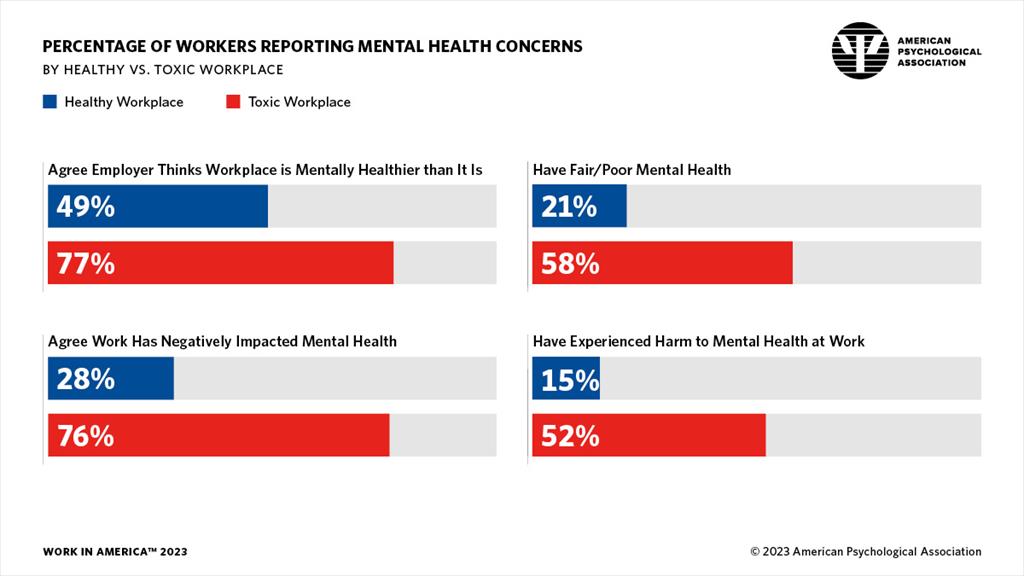
Those who reported a toxic workplace were more than twice as likely to report that their overall mental health was fair or poor (58%) than those who did not report a toxic workplace (21%). Likewise, more than three-quarters (76%) of those who reported a toxic workplace also reported that their work environment has a negative impact on their mental health, compared with fewer than one-third (28%) of those who did not report a toxic workplace.
Those who reported a toxic workplace were more than three times as likely to report having experienced harm to their mental health at work, compared with those who did not report a toxic workplace (52% vs. 15%, respectively). In addition, 77% of those who reported a toxic workplace also reported that their employer thinks their workplace environment is mentally healthier than it actually is, compared with 49% who did not report a toxic workplace.
Experiencing a toxic workplace is associated with certain demographic and workplace factors:
- More females (23%) reported a toxic workplace than males (15%).
- More people living with a disability (26%) reported a toxic workplace than those without a disability (16%).
- Employees working for nonprofit and government organizations were more likely to report a toxic workplace than those in private industry (25% and 26% vs. 17%).
- Those in upper management were much less likely to report a toxic workplace (9%) than those in middle management (21%), front-line workers (26%), and individual contributors1 (18%). (This finding raises the question of whether it may be difficult for upper management to relate to assertions of employees that a workplace is toxic when upper management may not, themselves, be exposed to that aspect of the workplace.).
Individual contributor is defined as someone with a middle level or senior position who does not have management responsibilities.
Too many customer/client/patient service providers are experiencing some form of verbal abuse at work
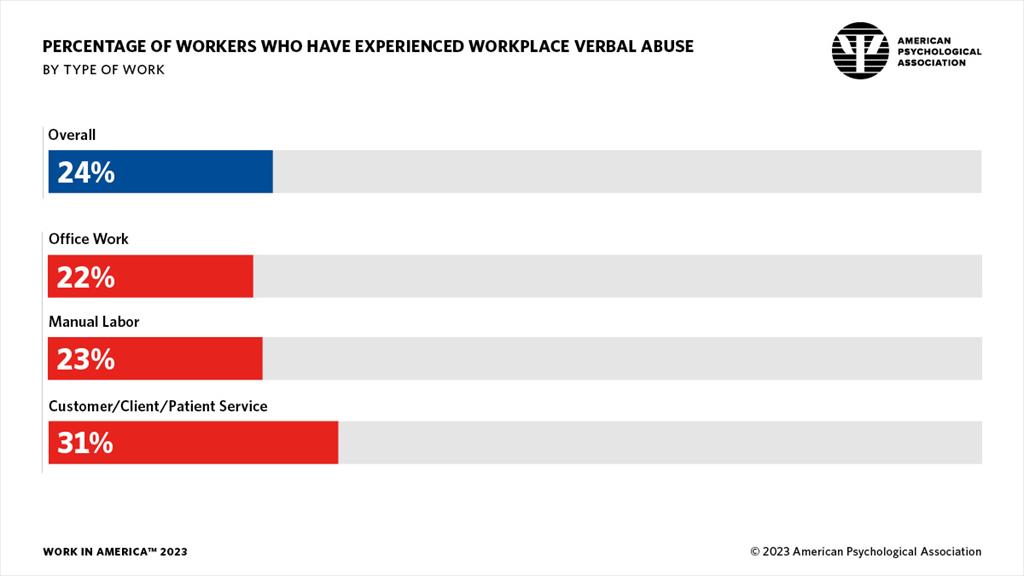
Almost one-quarter (24%) of respondents said someone within or outside their organization had yelled at or verbally abused them at work within the past 12 months. More than a quarter of those who work in person reported some form of verbal abuse (26%), which is significantly more than those who work remotely (18%). In addition, close to one-third (31%) of those who do customer/client/patient service reported some form of verbal abuse, compared with just under one-quarter of manual laborers (23%) and office workers (22%) who reported the same
Likewise, close to one in five (19%) reported having experienced bullying at work. Unfortunately, the percentage was significantly higher among those living with a disability (27%) than among those without a disability (15%). And when it comes to physical violence, approximately one in 10 manual laborers (12%) reported that someone within their organization displayed physical violence toward them, whereas about one in 20 office workers (5%) reported the same.
Discrimination in the workplace is still common
Fundamental to the surgeon general’s framework is the principle that employees should be protected from discriminatory workplace practices. However, more than one in five (22%) indicated witnessing discrimination in their current workplace and 15% reported experiencing discrimination.
In addition, nearly one-third (28%) reported having witnessed slights, insults, or jokes that devalued the identity or negated the thoughts and feelings of others based on their identity or background. Further, 19% said they were targets of such behaviors.
The discrimination being experienced was not limited to race, ethnicity, or gender. For example, one respondent, a full-time, female employee from the South, stated that the aspects of her job that have a negative impact on her overall happiness, mental health and well-being are:
Age discrimination, no room for growth, favoritism.
Another full-time, female employee from the South said that aspects of her job that have a negative impact on her overall happiness, mental health and well-being are:
The recent decision to suspend all remote work and return to the office 5 days a week, disability discrimination, supervisors scheduling meetings during lunch hours and not allowing breaks.
Connection and community
Most workers have it, but too many still experience loneliness, lack of belonging and a sense of rejection
The surgeon general’s framework emphasizes that organizations that create opportunities for social connection and community can help improve mental health and well-being. This workplace essential rests on two human needs: social support and belonging.
Most workers are generally satisfied with their workplace relationships
Encouragingly, 89% of respondents said they are very or somewhat satisfied with their relationships with their coworkers, and 86% indicated they are very or somewhat satisfied with their relationships with their managers or supervisors.
Similarly, 82% said their workplace fosters positive relationships among coworkers, and 79% indicated that their workplace fosters positive relationships between managers and the people they manage. Moreover, most workers (81%) indicated that their workplace provides opportunities for collaboration and teamwork.
One respondent put it this way:
My company is like family. We do care for one another and do believe that we are stronger when we work together.
Yet workplace loneliness is experienced by a meaningful percentage of workers.
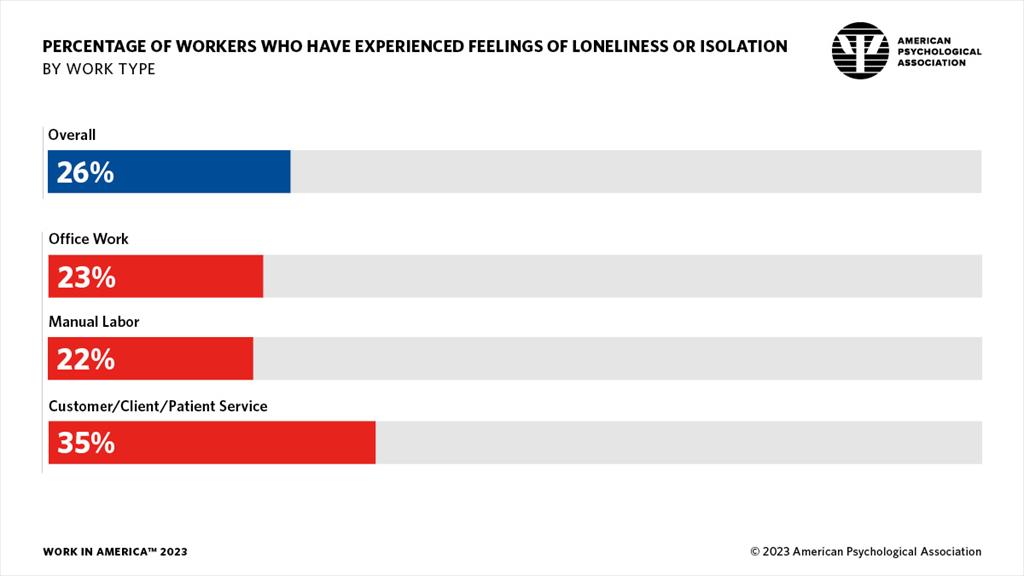
Although most workers report being generally satisfied with their workplace relationships, more than a quarter (26%) said they have experienced feelings of loneliness or isolation at work. Despite the fact that those workers interact with others frequently, the prevalence of feelings of loneliness was higher for those in the customer/client/patient service industry (35%) compared with those doing office work (23%) or manual labor (22%).
Moreover, these feelings were more prevalent among workers with household incomes of less than $50,000 (31%) compared with those with household incomes of $50K–$124.9K (24%).
Feelings of loneliness and isolation were not confined to remote workers. Indeed, 25% of fully in-person workers reported feelings of loneliness and isolation.
Certain groups feel they do not belong at work.
An overwhelming majority of workers (94%) said it is very or somewhat important to them that their workplace be a place where they feel they belong.
A male, part-time employee from the South, for example, stated that the aspect of his job that has the most positive impact on his overall mental health, happiness and well-being is:
They give me a sense of peace and that I belong here.
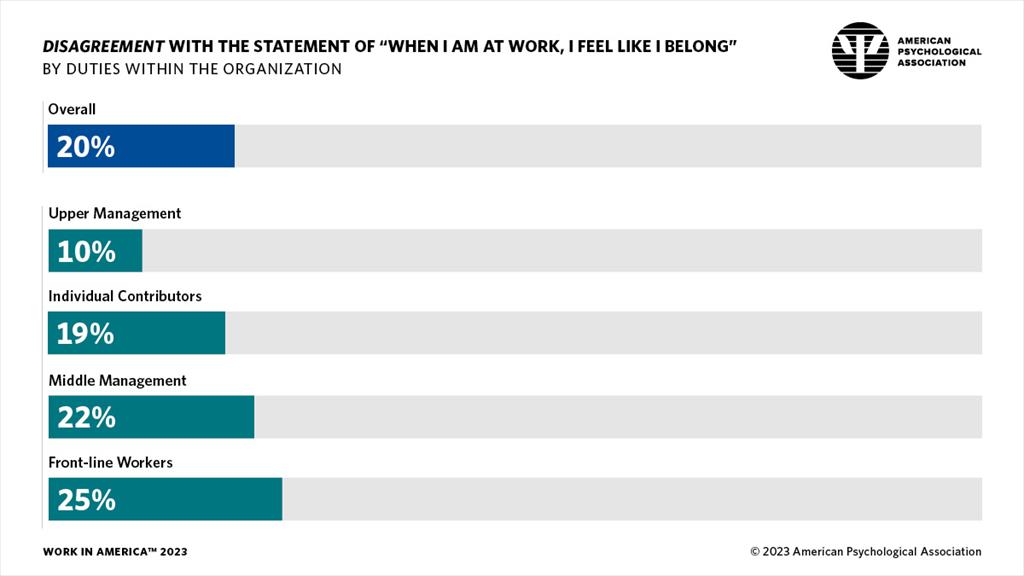
Unfortunately, one in five (20%) strongly or somewhat disagreed with the statement, “when I’m at work, I feel like I belong.” Black (23%) and Hispanic (22%) workers were more likely to feel a lack of belonging than their Asian (14%) colleagues.
Interestingly, only 10% of upper management employees did not feel a sense of belonging, compared with 19% of individual contributors, 22% of middle management, and 25% of front-line workers. This finding raises the question of whether it may be difficult for those in upper management to understand and relate to the lack of belonging felt by a quarter of front-line workers.
Certain groups feel unsupported because of their identities
Close to one-third (30%) of workers said they feel their workplace does not support them because of an aspect of their identity, such as race/ethnicity, gender, sexual orientation, ability status, age, etc.
This perceived lack of support was more common among workers ages 18–25 (45%) and 26–43 (34%), compared with workers who were 44 and older (11%–25%). Black and Hispanic workers were more likely to report feeling a lack of support from their employers (39% and 34%, respectively) than their White (27%) counterparts. In addition, the perceived lack of support due to identity was higher in LGBTQ+ workers (38%) compared with non-LGBTQ+ workers (29%)
Work-life harmony
Many workers are achieving satisfactory work-life harmony, but there is too little respect for time off
The surgeon general defines work-life harmony as the integration of work and nonwork demands through the human needs of autonomy and flexibility. Work-life harmony involves, among other things, the amount of control one has over the “how, when, and where” one does their work.
Work-life harmony is associated with psychological well-being
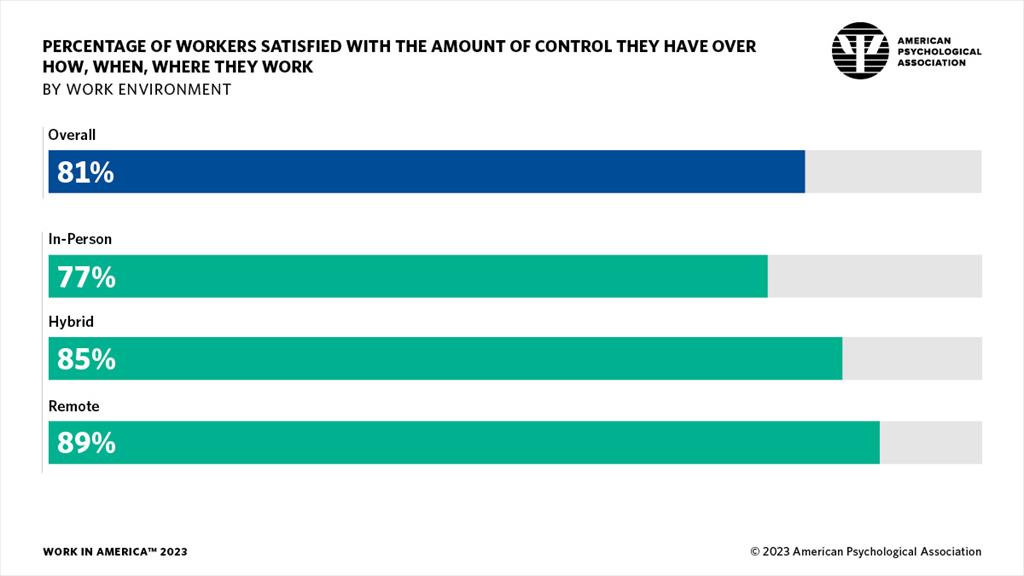
Approximately eight out of 10 respondents (81%) reported being either very (42%) or somewhat (40%) satisfied with the amount of control they have over how, when, and where they do their work. Importantly, those who reported satisfaction with their level of control were much more likely to report that their overall mental health level is good or excellent (79%) compared with those who reported being unsatisfied with their level of control (44%).
Similarly, those who reported satisfaction with their level of control were much less likely to report that their work environment has a negative impact on their mental health (32%) compared with those who reported being unsatisfied with their level of control (62%).
Work-life harmony also involves having enough flexibility to mitigate conflicts between work and home life. Workers who said they did not have the flexibility to keep their work and personal life in balance were more likely to report that their work environment had a negative impact on their mental health (67%) compared with those who did have that flexibility (23%).
When asked to list two or three things about her current job that have a positive impact on her mental health, happiness, and well-being, one female, full-time worker from the South stated:
I have control over my day-to-day activities and can set my own agenda for each day. There is paid sick leave if I need it. There is time off for holidays where I can rest and rejuvenate myself.
In contrast, when asked to list two or three things that have a negative impact on her mental health, happiness, and well-being, one female, full-time worker from the Northeast stated:
No control over schedule. Little to no work-life balance. Poor management.
Certain job characteristics and demographics are associated with work-life harmony
Those who work in hybrid or remote arrangements were more likely to be satisfied with the how, when, and where they do their work (85% and 89%, respectively) than those who work in person (77%). Remote workers reported being slightly more likely to have enough flexibility at work to be able to keep their work life and personal life balance (75%) than hybrid (67%) or in-person workers (66%).
Further, those ages 18–25 are more likely to agree that they do not have enough flexibility at work to be able to keep their work life and personal life in balance compared with those in older generations (41% vs. 26% of workers 44–57, 28% of workers 58–64, and 24% of workers 65+)
Other workplace and personal characteristics were also associated with satisfaction with the how, when, and where work is done. For example, office workers were more likely to be satisfied (86%) than those in manual labor (77%) or customer/client/patient service (76%).
Those at for-profit organizations were more likely to be satisfied (83%) than those at nonprofit organizations (73%). Those in upper management were more likely to be satisfied (93%) than those in middle management (81%), front-line workers (76%), or individual contributors (78%).
Finally, those living with a disability were less likely (77%) than those without a disability (84%) to be satisfied with this aspect of work.
Too many workers experience a lack of respect for their time off
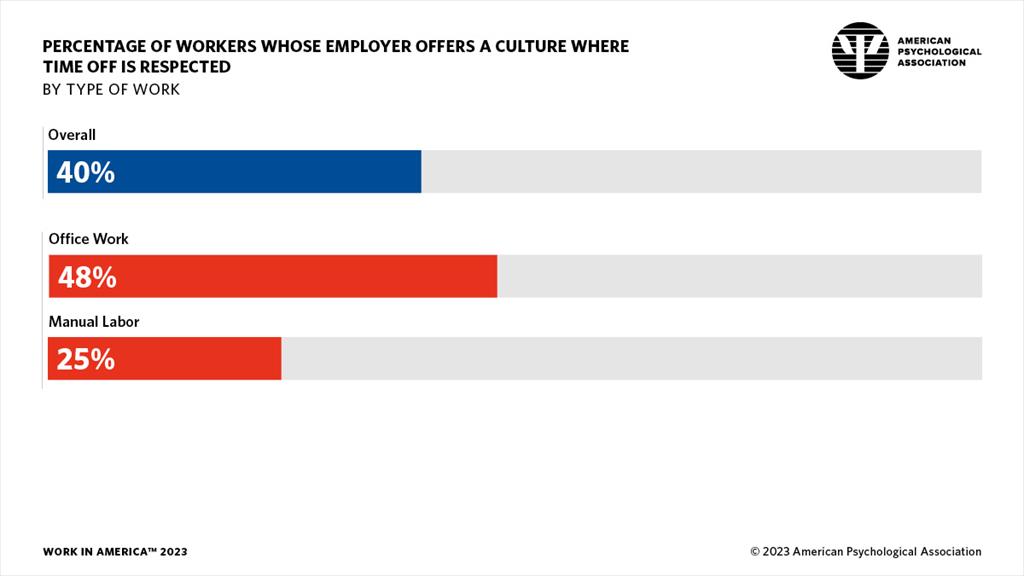
Unfortunately, more than one-quarter (26%) of respondents strongly or somewhat agreed with the statement, “my employer does not respect my personal boundaries.” Further, fewer than half of respondents (40%) reported that their employer offers a culture where time off is respected. Those who do office work were almost twice as likely (48%) than those who do manual labor (25%) to report respect for time off.
Those who work in an organization with racial or ethnic diversity in senior leadership were more likely than those who do not to report respect for time off (42% vs. 34%).
When asked to list the most important things your employer either is doing or should be doing to help protect and foster your emotional and psychological well-being, a male, full-time worker from the South stated:
Respecting boundaries and personal days.
Similarly, a female, part-time employee from the West said:
Respecting my boundaries and not calling me on my two days off to come in to work just because they need a body. I need those two days for personal reasons and will not budge. Also they are flexible if I need time off for doctor appointments and things like that.
Mattering
Workers want to matter at work and want their work to have meaning.
The surgeon general points out that people want to know they matter to those around them, which includes a sense of dignity and meaning. Indeed, 95% of respondents said that it is somewhat or very important to them to feel respected at work.
Mattering at work and meaningful work are associated with psychological well-being
Fortunately, 78% strongly or somewhat agreed with the statement, “I feel valued at work” and 87% strongly or somewhat agreed with the statement, “the work I do is meaningful.”
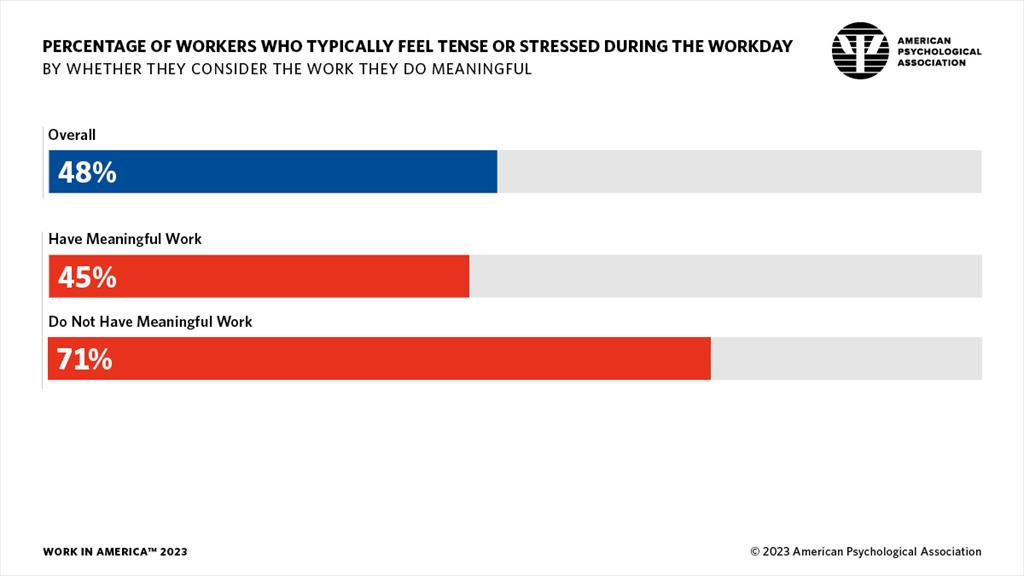
Those who reported not having meaningful work were much more likely to report that they were typically tense or stressed out during their workday (71%) than those who reported having meaningful work (45%)
Being micromanaged is associated with tension and stress
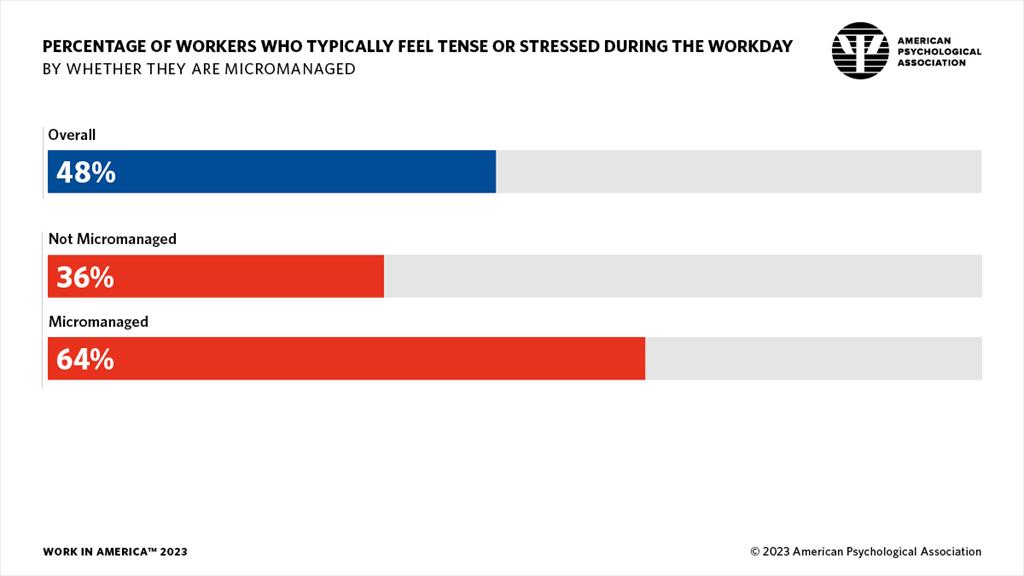
Four out of 10 workers (42%) reported feeling micromanaged at work. Those who feel micromanaged are much more likely than those who do not feel micromanaged to also report feeling tense/stressed during their workday (64% vs. 36%, respectively).
When asked what the most important thing is that his employer could do to protect and foster his emotional and psychological well-being, one full-time, male employee from the West stated:
Just not micromanage my time. Give me a job, give me a timeline, and leave me alone unless I ask for assistance.
Similarly, a female, full-time employee from the South said:
Stop micromanagement. It is so stressful to me. Let me do my job as hired to do
Opportunity for growth
Workers want and need opportunities for growth
This essential from the surgeon general’s framework is based on the human needs for learning and accomplishment. These needs are consistent with the survey results. The overwhelming majority of workers (91%) said it was very or somewhat important to them to have a job where they consistently have opportunities to learn, and 94% said it was very or somewhat important to them to have a job where they get a sense of accomplishment.
Although most workers are satisfied with their opportunities for growth, there is room for improvement
Almost three-quarters of respondents (74%) indicated they are very or somewhat satisfied with the opportunities for growth and development at their place of work. Over three-quarters of respondents (79%) said that they are very or somewhat satisfied with the opportunities they have to be innovative or creative in their work. More than two-thirds (70%) strongly or somewhat agreed with the statement, “I feel I can reach my highest potential at my current place of work.”
Opportunities for growth are associated with psychological well-being
Workers who were somewhat or very satisfied with their opportunities for growth and development more often reported good or excellent mental health (79%) than those who were unsatisfied (52%). Further, workers who lacked opportunities for growth and advancement were also more likely to typically feel tense and stressed out during their workday (66% vs. 42%).
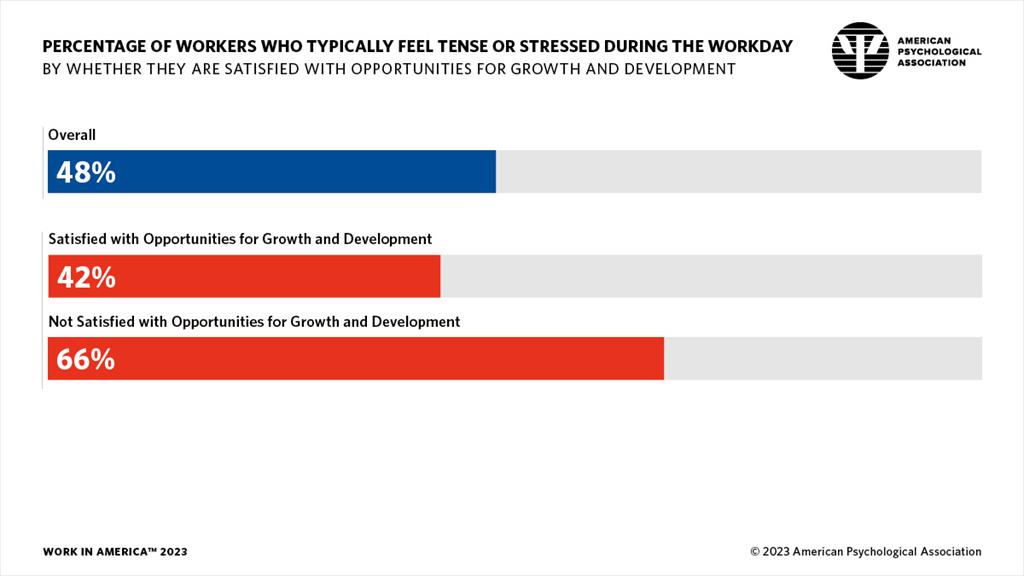
Certain demographic and organizational characteristics associated with satisfaction regarding opportunities for growth and development
Men were more likely to report being satisfied with growth and development opportunities (77%) than women (71%). Higher-income workers ($125,000+) also were more likely to report satisfaction with growth and development opportunities (79%) than workers making less than $50,000 (68%).
Workers in for-profit settings were more likely to report satisfaction with growth and development opportunities (76%) than those in nonprofit organizations (65%). Those who reported working for an organization with equity, diversity, and inclusion policies were more likely to report being satisfied with opportunities for growth and development (78%) than those in organizations without such policies (64%).
Those who reported working for an organization with racial or ethnic diversity in senior leadership were more likely to report being satisfied with opportunities for growth and development than those in organizations without such diversity (77% vs. 68%, respectively).
Overall, those who were satisfied with their opportunities for growth and development were far more likely to report being very or somewhat satisfied with their jobs (96%) than those who were not (64%).
Methodology
The research was conducted online in the United States by The Harris Poll on behalf of APA among 2,515 employed adults. The survey was conducted April 17–27, 2023.
Data are weighted where necessary by age, gender, race/ethnicity, region, education, marital status, household size, full-time/part-time employment, employment sector, industry, household income, and propensity to be online to bring them in line with their actual proportions in the population.
Respondents for this survey were selected from among those who have agreed to participate in our surveys. The sampling precision of Harris online polls is measured by using a Bayesian credible interval. For this study, the sample data is accurate to within ±3.1 percentage points using a 95% confidence level. This credible interval will be wider among subsets of the surveyed population of interest.
All sample surveys and polls, whether or not they use probability sampling, are subject to other multiple sources of error which are most often not possible to quantify or estimate, including, but not limited to coverage error, error associated with non-response, error associated with question wording and response options, and post-survey weighting and adjustments.
SOURCE: https://www.apa.org/pubs/reports/work-in-america/2023-workplace-health-well-being